Sunday, April 19, 2015

Week 3: Robotics + Art

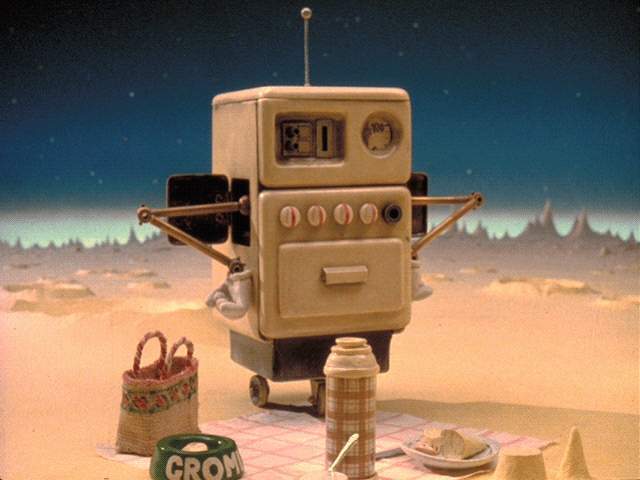
This week's topic of robotics in conjunction with technology and art brought on mixed feelings because my knowledge of robots and technology (besides phones) is limited. However, the first thing that comes to mind when I think of this topic is the movie A Grand Day Out With Wallace and Grommit, which is the earliest movie I can remember watching in my childhood. It's about a man and his dog who want to travel to the moon to sample cheese, so they build a spaceship in their garage to do so. When they arrive, they encounter a robot who immediately becomes agitated by them, but is interested in visiting Earth. The robot tries to manipulate them in order to come back to Earth with them. The incorporation of this concept obviously shows the influence of robotics on media in our world. It also presented to me at an early age that there might be reasons to fear robots and their intelligence. Along with other examples like Transformer, I Robot, and Frankenstein, it is clear the mathematical and technological world have a heavy influence on the works of artists today. 


Mechanization and industrialization are embedded in our history and, as shown in Professor Vesna's lectures, follows a vast timeline of iconic thinkers and inventions. These two subjects also have been show to elicit both inspiration and fear. With the introduction of the production line by Johannes Gutenberg's printing press (which can also be found almost 400 years earlier by the Chinese), mass production has brought ease into our lives but also eliminated the need for human labor. Henry Ford's assembly lines showed an even more advanced stage of this. Walter Benjamin, in his essay, The Work of Art in the Age of Mechanical Reproduction, expressed his belief that industrialization strips production of uniqueness and authenticity, as well as its place in history. Charlie Chaplin, in his silent film Modern Times, brings light to the struggle to keep up with industrialization in that time, and the threat of being replaced by machines in the production process, which can be used to support Benjamin's prediction. 


Citations


Vesna, Victoria. "Robotics + Art." DESMA 9. UCLA, Los Angeles. 1 Apr. 2015. Lecture.


Benjamin, Walter. “The Work of Art in Age of Mechanical Reproduction.” Marxists. N.p.. Web. 18 Apr. 2015. <http://www.marxists.org/reference/subject/philosophy/works/ge/benjamin.htm>.


Wallace & Gromit in A Grand Day Out. Oxford University Press, 2004. Videocassette.


Modern times (1936). Warner Home Video/Charles Chaplin Productions, 1986. Film.


Sunday, April 12, 2015

Week 2: Math + Art

Math is an often overlooked aspect of art. It is the foundation of many art pieces and is the driving force in some of the art advancements that have occurred throughout history. Additionally, art has been essential to much of  math's conceptualization. This week's lecture sought to reveal the relationship of art and math. Buckminster Fuller believed that we are all born as geniuses, and the educational system "de-geniuses" us by teaching us that art and math have no relation. Geometry drove one of the most basic art concepts, perspective, as demonstrated by Brunelleschi who coined linear perspective. Before perspective, portraits and other art works were less realistic and by incorporating these math concepts, art was taken to another level. The golden ratio is another example of mathematical elements that make it possible for art to be increasingly realistic and visually pleasing. 

The golden ratio is demonstrated in the Parthenon.

Leonardo Da Vinci is someone who truly mastered the balance of art and math. His works like the Last Supper, the Vitruvian Man, and the Mona Lisa are excellent examples of how he brought the two worlds together and today we still look to them for their astounding influence. 


The Vitruvian Man brought light to the relation between the body, nature, and architecture.

In my opinion, math sets out to define the world around us, while art represents and depicts it. Therein lies the juxtaposition between them and also the beauty of their codependence. 


References

 Vesna, Victoria. “Mathematics-pt1-ZeroPerspectiveGoldenMean.mov.” 12 Apr. 2015. <http://www.youtube.com/watch?v=mMmq5B1LKDg&feature=player_embedded>

"Vitruvian Man, The Proportions of a Human Figure." Leonardo Da Vinci. N.p., n.d. Web. 12 Apr. 2015. <http://www.davincilife.com/vitruvianman.html>.

"Golden Ratio." Golden Ratio. MathsIsFun.com, 2014. Web. 12 Apr. 2015. <https://www.mathsisfun.com/numbers/golden-ratio.html>.

"Leonardo Da Vinci." Wikipedia. Wikimedia Foundation, n.d. Web. 12 Apr. 2015.

Wander, Rodrigo. "Origami." Origami. Minhateca, n.d. Web. 12 Apr. 2015. <http://minhateca.com.br/Rodrigowbs/BR+DeepWeb/Apostilas/Apostilas+de+Japon*c3*aas/Origami>.


Sunday, April 5, 2015

Week 1: Two Cultures

I believe I am a product of the "third culture" being a sociology student at UCLA. While it is technically a north campus major, to me, it is the perfect blend of science and art. We think about abstract concepts in technical ways, using statistics and measurements when necessary. We take the concrete - the way people behave - and pick it apart and look for the underlying, intangible forces that drive their actions.


http://www.everydaysociologyblog.com

I deal with the middle ground between art and technology in a professional sense because I am currently an intern at an agency and showroom. For many, an agency is a foreign concept, but the most basic explanation of it is that it is the business side of brands that helps them grow and market their company. This particular agency only represents four brands, which are technically classified as lifestyle brands. They seek to create a way of living that the consumer can attain or be a part of by purchasing the product they sell. For example, one brand we represent sells bicycles, but also aims to embody the "Venice lifestyle" where ease, style, adventure collide. To the customer, not only are they purchasing a bicycle, but a ticket to this lifestyle.


http://www.indian-summer.co

The lifestyle aspect of a brand is largely established by and dependent on their social media presence. Because of the undeniable influence and growth of technology in today's sales and marketing, a huge part of what I do at with this agency is managing the social media outlets of these brands. One quote my boss looks to operate by is "a good advertisement is one which sells the product without drawing attention to itself." It is a balancing act to find how to utilize technology to reach optimal number/type of consumers, while also using art to create beautiful and enticing advertisements and curate a vision that represents the brand in a particular light.


http://www.huffingtonpost.com

The showroom that I work at, where four brands coexist in one space. 
http://www.staywildmagazine.com


Sources
Bohm, D. "On Creativity." JSTOR. N.p., n.d. Web. 04 Oct. 2013.
Snow, C. P. “Two Cultures and the Scientific Revolution.” Reading. 1959. New York: Cambridge UP, 1961. Print.

Vesna, Victoria. "Toward a Third Culture: Being In Between." Leonardo. 34 (2001): 121-125. Print.

Brockman, John. The Third Culture. N.p.: n.p., 1995. Print.

Snow, C.P. The Two Cultures: And a Second Look. N.p.: n.p., 1963. Print.